Lynnwood WA Housing Market Trends Shaped by Growth
June 25, 2026
June 25, 2026
Change is no longer a future headline in Lynnwood. It is happening now, and you can see it in new transit, major redevelopment plans, and the mix of homes coming to market. If you are thinking about buying or selling in Lynnwood, understanding how that growth is shaping the housing market can help you make smarter decisions. Let’s dive in.
Lynnwood’s growth story starts with transit and long-range planning. Sound Transit opened the Lynnwood Link Extension on August 30, 2024, bringing light rail to Snohomish County for the first time and adding the Lynnwood City Center station along with other new stations and parking structures. That added regional access to places like downtown Seattle and SeaTac, which has made Lynnwood more appealing for people who want stronger transit connections.
The city is also planning for growth in a very intentional way. Lynnwood adopted its 2044 Comprehensive Plan in January 2025 and amended it in November 2025, which shows that its growth framework is both current and active. Instead of letting growth happen randomly, the city is directing much of it toward key areas where infrastructure and redevelopment can support it.
The clearest example is Lynnwood City Center. The city describes this area as a place meant to become a vibrant commercial center and a more attractive place to live, work, and spend time. That vision is already taking shape through multifamily construction, planned office space, planned retail, and utility and street upgrades.
According to the city, the area already has more than 500 multifamily units under construction and another 1,400 units entitled. It also has more than 500,000 square feet of office planned and another 200,000 square feet of retail planned. That is a meaningful pipeline for a city Lynnwood’s size, and it helps explain why the housing conversation is changing.
The City Center + Alderwood Subarea Plan shows just how concentrated this growth could become. The plan area covers about 1.2 square miles, or roughly 15% of Lynnwood’s land area, and is organized around two light rail stations tied to the Lynnwood Link and future Everett Link extensions. In the city’s May 2025 draft plan, the preferred growth scenario projected housing units in the regional growth center rising from 1,799 in 2020 to 14,832 by 2044.
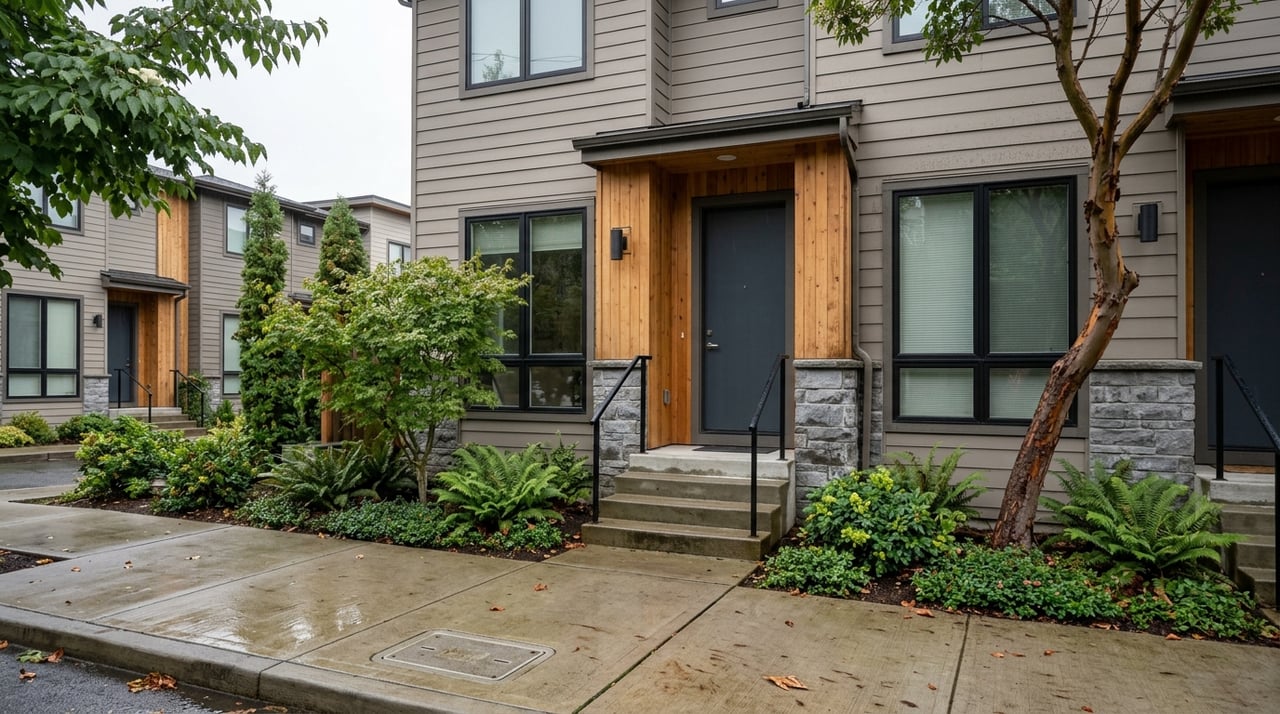
Lynnwood is not becoming one single kind of housing market. It still has a strong single-family foundation, but much of the new growth is denser and more transit-oriented. That means the city is adding variety rather than replacing every existing neighborhood pattern.
A city housing review says about 65% of Lynnwood’s land is developed with single-family residential uses. The same review, using 2017 ACS data, showed a housing mix of 52% single-family homes, 37% multifamily, 7% triplexes and quadplexes, 3% townhouses, row houses, or condos, and 1% duplexes. Those numbers are best viewed as a baseline, but they help explain why new apartment and mixed-use projects stand out so much today.
Recent city project pages show that much of the current pipeline is focused on apartments and mixed-use development. Examples include ENSO, a 318-unit apartment project with retail, KOZ @ Alderwood, a 199-unit multifamily building near the Lynnwood City Center station, and Northline Village, a mixed-use project with housing, retail, office, and entertainment uses. The city also expects City Center housing to continue shifting from single-story commercial properties to mid-rise residential construction.
Transit is only part of the story. Lynnwood is also using local policy tools to guide what gets built and where. That matters because market change is often tied to zoning, tax incentives, and permitting, not just buyer demand.
The city’s multi-family property tax exemption program is designed to encourage apartments and condominiums in the City Center subarea. As of June 2026, Lynnwood is also developing a pre-approved DADU program to make accessory unit permitting faster and more predictable. Together, those steps point toward a housing market with more choices near transit and a broader range of housing forms over time.
Even with all this growth, Lynnwood is still a competitive housing market. The difference is that conditions look more balanced than they did during the peak seller-market years. Buyers still need to move with purpose, but pricing has become more sensitive.
Redfin reported that in the three months ending May 2026, Lynnwood’s median sale price was $739,557, down 1.0% year over year. Homes took about 10 days to sell on average, buyers were seeing about 2 offers per home, and 31.4% of homes had price drops. Redfin also reported that the average home sold for about 1% below list price.
Zillow’s data tells a similar story from a different angle. As of May 31, 2026, Zillow showed 262 homes for sale in Lynnwood, a median sale price of $730,333 for April 2026, and a Zillow Home Value Index of $777,866, down 2.6% year over year. These figures are measured differently, but together they suggest a market with more inventory and less rapid price growth than many buyers and sellers saw a few years ago.
Countywide context matters too. In April 2026, NWMLS reported a median closed price of $750,000 in Snohomish County, with active inventory up 56.2% year over year and 2.77 months of inventory. That tells you Lynnwood sits within a county market that remains somewhat supply-constrained, but not nearly as tight as the most intense low-inventory period.
One of the biggest mistakes buyers and sellers can make is treating Lynnwood like a single price band. It is not. Values vary meaningfully depending on property type, location, and how close a home is to newer growth patterns and amenities.
Zillow’s neighborhood pages show this clearly. As of the reported data, North Lynnwood was at $648,626, Silver Lake at $700,627, Alderwood Manor at $860,195, and Meadowdale at $928,171. These are Zillow-defined neighborhood geographies rather than city planning districts, but they still show that different parts of Lynnwood behave differently.
That variation matters in a growing market. A transit-adjacent condo, an established single-family home, and a property near a redevelopment corridor may all attract different buyers and face different pricing dynamics. Looking only at citywide averages can hide those differences.
If you are buying in Lynnwood, growth could create more options, but not evenly across the city. The biggest increase in supply is likely to show up in City Center and the Alderwood transit corridor, where apartments, condos, and other denser housing types are being concentrated. Established single-family areas may still remain relatively limited by comparison.
That can work in your favor if you stay flexible. You may find newer housing opportunities near transit, retail, and mixed-use development that did not exist a few years ago. At the same time, if your goal is a detached home in a more established part of Lynnwood, you may still face tighter choices and stronger competition.
It also helps to think long term. Light rail and redevelopment may support demand near transit, but they do not automatically push every property value upward at the same pace. Inventory levels, mortgage rates, housing type, and property condition still play a big role in what makes a home a smart purchase.
If you are selling, Lynnwood’s growth is still a positive story, but it is not a substitute for strategy. Homes are still moving relatively quickly, yet buyers are showing more price discipline than they did during the hottest years of the market. That means strong presentation and accurate pricing matter more than ever.
Growth can also change how buyers view your home. If your property is close to transit, new retail, or an area seeing major reinvestment, those factors may add appeal for some buyers. If your home is in an established residential area, your value story may be more tied to layout, condition, lot, and available inventory in that specific segment.
In other words, sellers should not rely on broad headlines alone. The right list price and marketing approach depend on where your home sits within Lynnwood’s changing map, not just on whether the city as a whole is growing.
Lynnwood is becoming more urban in targeted areas, especially around City Center and Alderwood, while still keeping much of its single-family framework in place. That makes this a market in transition rather than a market that has fully changed form. For buyers and sellers alike, that creates both opportunity and nuance.
The most important thing to watch is not just whether Lynnwood is growing, but where it is growing and what kind of housing that growth is adding. When you understand that, it becomes much easier to judge pricing, compare options, and plan your next move with confidence.
If you want a clear, local read on how Lynnwood’s growth may affect your next move, Bruce Overstreet offers thoughtful guidance backed by deep Snohomish County market knowledge.
Stay up to date on the latest real estate trends.
Get assistance in determining current property value, crafting a competitive offer, writing and negotiating a contract, and much more. Contact Bruce today to discuss all your real estate needs!